Tuesday, March 25, 2014

Control Your Cruise


Modern cars go much further in preventing driver fatigue than the cars from years past. Anything the engineers can do to make the car more pleasant to drive is a good thing. One feature that does this very well but that has actually been around for a very long time is cruise control. This feature is not new but it has evolved tremendously and really doesn’t function at all like it used to.

The first cruise control systems used canister with a rubber diaphragm attached to a cable that would hold the throttle open when engine vacuum was applied to one side of the diaphragm. When the driver wanted to increase the set speed a vacuum solenoid would allow more vacuum in to act on the diaphragm. When the driver would hit the brake a valve attached to the brake pedal would let all the vacuum out and the throttle would snap shut.

Newer systems started using more electronic controls such as a small electric solenoid that could pull on a cable to hold the throttle open at the set speed. These systems looked at vehicle speed sensors to make sure they were accurately maintaining the set speed. A change in the set speed caused the electric solenoid to pull the throttle open more or allow it to close. When the driver hit the brake pedal an electronic switch would signal the actuator to release the throttle.

Electronic throttle control makes cruise control simpler.
Every car today whether it has cruise control or not is equipped with electronic throttle controls. The gas pedal is no longer attached to a cable that goes through the firewall to pull the throttle open. The gas pedal is attached to a sensor that tells a computer the driver wants more throttle. The computer then commands an electronic motor to open the throttle the requested amount.

Since there is a computer controlled actuator working the throttle, the only thing we need now to make cruise control work is a switch that tells the computer to hold the throttle open even when there is no foot on the gas. So the sensor attached to the gas pedal, and the buttons for the cruise control signal the same computer. This is a good example of computers simplifying the systems under the hood. A cruise control actuator and all the associated linkages are no longer needed.

This is not where the evolution of cruise control ends. Many cars are also now equipped with what is known as adaptive cruise control. This will not only hold the vehicle at a set speed but it will also reduce speed as needed to keep from getting too close to the vehicles in front of you that are traveling more slowly. The driver not only sets the cruising speed but they can also set the minimum following distance.

At the front of the car there is a sensor that uses lasers that bounce off the car in front of you to measure the distance between you and them. The computer will reduce the cruising speed as needed so you don’t get too close and once the car in front of you moves or speeds up the car will go back to the set cruising speed.

Adaptive cruise control won't let you get too close to the a slower car.
Adaptive cruise control is certainly one of those features that may cause us shake our heads in regards to the many new and somewhat silly features that we find on cars today, but of course this is where we are. In many ways these features that seem silly can actually make the car safer to drive by reducing driver fatigue and distraction. So while it seems that cruise control is the same as it ever was, it turns out it isn’t.  

Thursday, March 20, 2014

Deceptive Lights: Check Engine Light


Everyone out there has probably had a car that had a check engine light come on at some point. Some of you might have even had one blink at you furiously. Sometimes, the illumination corresponds perfectly with the engine running rough, fuel economy falling into the basement, or the transmission shifting funny. Sometimes nothing seems different in the way the vehicle runs at all. Either way, anytime the light illuminates it means something is broken. However, when the check engine light illuminates, it probably doesn’t have anything to do with the engine itself. This can make the check engine light deceptive.

This little light of frustration and angst will illuminate anytime the engine control computer sees a failure in the powertrain controls that will cause an increase in vehicle emissions greater than 150% of the federal test standard. This means if something breaks and it causes your car to potentially pollute more than normal, the computer will turn the light on. Most of the time this failure is electronic in nature, and not mechanical.

The check engine light varies somewhat from one vehicle to another. Federal law dictates what it can be, but there are several options. The light must be amber (yellow-ish) in color. The light may say “Check Engine” or it might say “Service Engine Soon.” It may appear as a silhouette of an engine alone, or it make appear as a silhouette of an engine with the word “check” or a strange lightning bolt arrow in the middle.
Many old cars from the early days of computer controls may have used something completely different for the check engine light. On these old cars every manufacturer could do whatever they wanted when it came to this malfunction indicator lamp. Honestly, most cars back then were not smart enough to illuminate whatever they used for a check engine light when the vehicle experienced most failures, so the check engine light was not a very useful thing.

Federal laws regulating exactly what the check engine light should look like and exactly when and how it should illuminate didn’t become standardized until the 1996 model year. These new standards which are still in use today are known as OBDII. These standards came about to make things such as check engine lights simpler for vehicle drivers to understand, and to make the problems for which they illuminate easier for technicians to diagnose.

The most common failures that cause the check engine light to illuminate relate to the engine not running right at its most efficient. This inefficiency can cause rough running, stumbling, hesitation, lack of power, poor fuel economy, and of course increased emissions. Sometimes the engine will not seem to run any differently than normal, but this is not always perceptible to the driver, so if the light comes on it must be diagnosed.
Many times you will take your car into the shop to have the check engine light diagnosed and the technician may not be able to figure anything out right at that moment. Rather than educate you on the situation and the nuance of intermittent problem diagnosis, they may leave you with the impression that nothing is really wrong and sometimes lights like this just come and go. This is never true. If the light is really coming on for no reason it's because something is broken. If the light is coming on for a reason then something is broken. No matter how you slice it something is wrong. 
A scan tool that can be used to read diagnostic trouble
codes that caused the check engine light to come on.

Diagnosing an intermittent failure that causes the check engine light to illuminate can be difficult and can take time. Be patient with your mechanic and understand that the time they spend working on this issue should not some free. Their time is their livelihood and you must pay for it even if it seems as if progress comes slowly. You would be patient with a doctor trying to figure out a physical ailment so you ought to show the same patience with your mechanic, after all, he can't ask your car where it hurts.

The check engine light must also not be confused with service monitors. Many vehicles have systems that can monitor the time and mileage intervals that elapse between vehicle services such as oil changes and tire rotations. Some of these monitors are very sophisticated, and some of them simply count the miles for you. A service indicator might say something such as “Service Vehicle Soon” or you might see a small illuminated wrench. To make things more confusing the vehicle that uses the service vehicle soon indicator might also have a check engine light that says service engine soon. These are totally different but can be really confusing if your vehicle has both of them.

Consult the owner’s manual for a proper explanation of the maintenance monitors and the associated indicators. The manual will tell you how they work, and it will even tell you how to reset them most of the time. The check engine light on the other hand has no simple reset procedure. If it comes on, something must be repaired.

The one thing that is usually certain is that the illumination of the check engine light has nothing to do with the engine itself. Some people worry about the pistons and valves and other mechanical components of the engine when this light comes on, but most of the time these things are fine…most of the time. 

Sunday, March 2, 2014

Monitoring the Thermostat


This is not that control panel on the wall of your house that you argue with your significant other over where the ideal setting should be. The thermostat is a control valve within the cooling system of your engine. Like the control panel for the furnace in your house, the engine thermostat is used to regulate temperature.

When the engine is cold the thermostat is closed, so coolant flow is restricted. This allows the coolant to heat up much more quickly because it cannot make its way out to the radiator where heat is released from the coolant into the outside air. The thermostat is located at the coolant outlet pipe coming from the engine going to the radiator.

Normal engine operating temperature is about 190 to 200 degrees F. Once the engine gets to a temperature close to this, the thermostat will open automatically. Most thermostats contain some kind of device that expands and contracts with temperature. When this thermally reactive unit gets hot it pulls the valve open allowing coolant to flow.

There are no fancy computer controls at work here, just old fashioned thermal expansion causing this thing to open. When the coolant gives off enough heat in the radiator to start bringing down engine temperature, the thermostat will react by closing slightly until the engine temperature is maintained at the optimum level for which it was designed.

Two problems result from a thermostat that has malfunctioned, but only one of them is well known because it leads to massive engine failure. The first and most dramatic thing that could happen when a thermostat goes bad is overheating. A bad thermostat can cause this when it simply fails to open at the proper temperature, or it gets stuck while opening and fails to open all the way.

When the engine overheats, the coolant heats up way past 190° to a point where the expansion of the various metal parts of the engine cause the parts themselves to fail. An engine can run safely up to about 230° F with no problems. When the temperature gets much above that the coolant can boil. Once the coolant boils it will build very high pressure in the cooling system and will boil over past the radiator cap or through the coolant expansion tank. This is why you see steam coming from some cars broken down by the side of the road. If temperatures get up to about 250° F the possibility for engine damage becomes a reality. Parts get weak and cylinder pressures go through the roof, literally.

The other thermostat failure that is not as well known but is probably just as common is overcooling. This is of course the opposite of overheating. Instead of the thermostat being stuck closed, overcooling happens when the thermostat is stuck open. If the engine is not allowed to warm up with the thermostat blocking coolant flow, it might not reach operating temperature at all.

Overcooling does not lead to a dramatic meltdown of expensive engine parts, which is why it goes undetected so much of the time, but it is still a problem that should be fixed. When an engine does not reach operating temperature it will not be able to maintain the correct air/fuel ratio. It will run rich, or with too much fuel. This is going to have an impact on fuel economy, but it will also have an impact on how much power the engine produces, and how much pollution will come from the tailpipe.
A typical engine that suffers from a thermostat that is stuck open might run as cold as 140° F. This might not seem that cold but it is. At this temperature you likely will not see your engine temperature gauge move very high off the lowest readings. In addition to this your heater performance will most certainly suffer. On those cold days when ambient temperatures are below 0, your engine will never come close to heating up, and you will probably have frost develop on the inside of the windshield.

Diagnosing a bad thermostat is no problem for an experienced technician. Many times a good repair shop will also recommend thermostat replacement anytime any work is done on the engine near the thermostat, regardless of whether or not it is currently known to be bad. Thermostats commonly go bad at inconvenient times, and considering it’s a $10 part, you should have it replaced anytime your mechanic is in the area.


Keeping the thermostat working will keep your engine running better, keep your fuel economy and power output up. And keep you from suffering a major breakdown from overheating in the middle of nowhere. Don’t forget about your thermostat, it would be a shame for a $10 part to cause so much grief. 


Monday, February 24, 2014

Used Car Drowning


Buying a used car off the lot or even from a private seller is never a comfortable thing for most people. The last thing you want to do is spend a hefty chunk of change on a new ride, and then have to spend a pile more on repairing some kind of hidden, preexisting condition.

One major problem that really does exist is a used car that has been in a flood. A car that has been underwater is a car that could have some very extensive problems. These cars come from places where some kind of natural disaster has occurred that has submerged hundreds or perhaps thousands of cars at once. Hurricanes such as Katrina or Sandy are prime examples of storms that have decimated the automobile population in their respective areas.

Insurance companies pay out millions in claims to compensate the owners of these vehicles. The cars are then sold as totaled vehicles and given special salvage title status. Sometimes in the shuffle of moving this metal away from the scene, the insurance companies sell them to third parties that do everything from scrap them, to fix them and return them to the road.

A certain portion will get into the auto auction circuit where they will be sold as a running vehicle but it will carry the salvage title status. Some may have lost their salvage title status when they were transported across the country from state to state. Some may be damaged in a flood but they never receive the salvage title status because the insurance company paid out to fix it, rather than replace it. If the car is repaired that doesn't mean that it's as good as new.

With a flood car the potential for severe damage is huge, and that potential exists for every part or system within the vehicle. If water is in the engine for just a few days it can cause rust which may either result in immediate problems, leading to immediate engine failure, or it may result in premature engine failure over a longer period of time. Just enough time for someone to buy it thinking everything is fine.

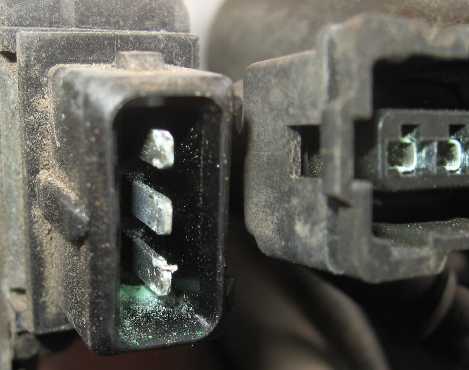
Corrosion on the terminals of an electronic sensor.
Electronic systems are extremely susceptible to flood damage. Every car on the road has so much wiring and so many computer controlled systems that it is impossible for a flood car to escape electrical damage. Corrosion in electrical connectors or computerized control modules is extremely difficult and expensive to repair. Many electronic failures that result from flood damage might not show up for years after the car has been returned to service. You might say that water damage does not necessarily destroy the car right away so much as it causes the car to lose years off of its usable life.

Besides things such as a Carfax report, the way to tell if a car has been in a flood is to look for obvious things that you don’t see on any normal car. Look under the seats at the seat tracks for rust or corrosion. Nothing inside a car should ever show the least sign of rust. Look in the trunk where the spare tire is located for similar rust and corrosion. The spare tire well may end up holding water for several weeks after the flood. Hidden areas underneath carpet or the dash are great places to look for water damage. 

Rust on metal parts that are not exposed to the elements is not normal, water damage in the carpets and seats may show as water stains or even signs of mildew might be visible, especially if you live in a place that is humid. Even in very dry places water can stay trapped inside headlight and taillight assemblies forever. Sometimes moisture or condensation will appear behind an instrument cluster lens. Many times if the water does eventually dry out it may leave behind strange residues in places where you should never see them.

Under the hood, take a moment to disconnect some of the electrical connectors that you find. These connectors are weather resistant but they are not exactly water proof. When submerged they will fill up with water and all of the pins will corrode. If you see any scale buildup, or if the pins are anything other than shiny and new looking, then they have been wet.

Some used car dealers will sell flood cars very cheap and they may even inform you that it is a flood car. Do not take a chance on any of these even if they seem to run very well and the dealer assures you they are a great value. The dealer might have honestly checked the vehicle out thoroughly, but there is no way they can see every potential problem, even if they try.


If you find out that your vehicle has been in a flood, be prepared for the worst. This does not mean that the engine is going to blow up and leave stranded on the side of the road, but don’t be surprised if it does. When you get rid of the vehicle do not expect top dollar if you sell it, and you need to disclose the vehicle history to your potential buyers. Just like you they must be made aware, because when they buy that flooded car, they need to know what they are getting into.

Monday, February 17, 2014

Home of an American Icon

National Corvette Museum


The following is an entry that I had written for this blog, and then the events of February 12, 2014 changed things a bit. I have left my original words intact, but then I decided to add an addendum with some of my thoughts on the events of that fateful day.

When you think of Kentucky you think of bluegrass, race horses, fried chicken, and maybe college basketball. Car guys and gals will think of the Chevy Corvette. Bowling Green, Kentucky in the south central part of the state is the unofficial home of one of America’s greatest automotive icons. Bowling Green is where the Corvette is manufactured and it is also the home of the National Corvette Museum.

Finding myself in this part of the country recently I planned a visit to this motoring mecca. When I was a little kid one of the first statements I ever made on a routine basis was, “Neat car!” According to my mother I would usually shout this phrase excitedly whenever a Corvette would drive by. As you can imagine visiting the town that’s the home of the Corvette would be a priority.
 
The Indy Corvette Concept. This was
on my wall in poster form in 1987.
The Corvette was introduced by Chevrolet back in 1953. At 60 years old the Corvette is the longest running car model sold in the United States. The model has been offered every year except 1983 because of a major redesign that was not quite ready. In the Fall of 2013 Chevrolet released the 7th generation of this iconic sports car.

The Corvette is fantastic because it has always given excellent bang for the buck. Performance wise, it has always been competitive with cars that were and are much more expensive. The Corvette has always kept up with the likes of Ferrari and Porsche and it has done so at a fraction of the cost.

The National Corvette Museum is right next to Interstate 65 on the east side of town. This is the biggest museum in the country dedicated to one single model. The museum is amazing in the way it chronicles everything the Corvette has ever been. The plant where they build the Corvette is just north of the museum. Because of poor timing and my usual bad luck, I was unable to tour the factory. With the recent advent of the 7th generation Corvette, the factory was in the process of retooling and rolling out the new model so they were not allowing tours for much of the past year.

The museum however was one of a kind and definitely made the visit to Bowling Green worthwhile since I was in the area. The museum starts out with the history of the Corvette, and what a history it is. Considering how long the car has been in production there is much to see and they show you everything. Every model that has been produced over the years can be seen in the history section. Many famous people involved in developing the Corvette or other celebrity enthusiasts have their cars on display. Zora Arkus-Duntov, perhaps the most influential engineer in Corvette development only ever owned one Corvette in his life and you can see it on display.
 
The only Corvtte that Zora Arkus-Duntov ever
personally owned. A not so exciting 1974.
A section of the museum dedicated to Corvette development and engineering has displays on what GM has done over the years to keep this vehicle on the cutting edge of automotive performance. This part of the museum displays many of the original concept vehicles that Corvette engineers developed over the years, in order to try new ideas and see how they work. My personal favorite in this section was either the original C6 that set a new lap record time at the Nurburgring in Germany, or the Indy Corvette concept that brought back memories of the posters on my bedroom wall when I was a child.

The Performance section of the museum is dedicated to the many racing iterations of the corvette and contains many of the original racing versions of the Corvette. In the late 50s the world of motorsport realized they had a great car for racing so since that time many different racing classes have existed that use the Corvette. This section also had many different engines on display. For a motorhead such as myself seeing the various Corvette engines souped-up for racing is a treat. My long suffering wife is a saint in places like this.
 
The 2009 ZR1 That set a Nurburgring lap time record.
Perhaps my favorite room in the museum was the Skydome. Under this modern vaulted structure many interesting and unique corvettes can be found. High performance Lingenfelters and Callaways, both leaders in aftermarket Corvette performance. Several Indy 500 pace cars are also on display. The only 1983 Corvette ever made is on display. The 1983 model year was skipped because they were gearing up for major changes for the 1984 model year. Too many cool things to list were found under the dome.

The National Corvette Museum is open nearly every day, and hosts many special events each year. This museum is truly amazing for a car lover. So if you think Corvette whenever you think of Kentucky, you will enjoy spending some time in Bowling Green.

The only 1983 Corvette ever made. That year was skipped while Chevy tried to work out all the particulars for the change to the new C4 Corvette.
The skydome is the best part of the museum.
A line of pace cars from the Indianapolis 500.
1953, The first of them all.
A 1967 Convertible.


Addendum:

On February 12, 2014 a massive sinkhole opened up underneath the skydome portion of the National Corvette Museum. The hole appears to be about 40 ft. wide and about 20 ft. deep. No one was hurt in this horrible tragedy because the floor gave way early in the morning while nobody was around. The sinkhole swallowed 8 rare and collectible Corvettes:

2009 ZR1 "Blue Devil"
1993 ZR1 Spyder (one of a kind)
1962 Convertible
1984 PPG pacecar (one of a kind)
1993 40th Anniversay Edition
1992 1 Millionth Corvette (one of a kind) 
2001 Mallett Hammer Z06
2009 1.5 Millionth Corvette (one of a kind)

All of the other cars in the skydome escaped without damage, and museum personnel were able to remove some other especially rare cars such as the only 1983 Corvette ever built. The museum has posted many different videos of the sinkhole and the evacuation of the remaining cars from the skydome so that fans such as myself could be unproductive at work while we are wrapped up in seeing everything that happened. They even had engineers and geologists from Western Kentucky University fly a drone down into the hole to inspect the situation. These videos are also posted on YouTube.

The Blue Devil front and center, in the hole. The white one on the left is the 1 millionth corvette, it is now in the hole;
The white one with the black stripes is the 1.5 millionth, it is in the hole; The one up on the stand in back with the hood open in the ZR1 Spyder, in the hole. The center of the hole seems to be right where the blue one is sitting, its surprising that it ended up on top. This is a photo I took on my visit. 
This part of Kentucky has massive limestone layers just under the surface of the Earth. Limestone, combined with run off from all the rain they receive annually creates massive, seemingly endless caves that extend everywhere underground. Mammoth Cave National Park is the longest cave system in the world and is located about 30 minutes from Bowling Green. When you drive through the area on I-65, much of the green fields and rolling hills are pock marked with sinkholes. Imagine driving across the surface of a giant golf ball.

This event is tragic because the cars that were swallowed up in the earth are rare, collectible, valuable, and just fun to see. To think of something that should be pampered getting treated with so much disrespect is difficult. Not to mention that any car guy out there who would love to own one of these fine machines, just can't fathom the idea of throwing them out with the trash as Mother Earth has done. The total value of the cars is hard to estimate exactly but it's in the millions. The most valuable of them all being the 1992 1 Millionth Corvette which is probably worth about 400k.

One person commenting on one of the websites reporting on this story stated that this was an act of God because he loves the new C7 Corvette so much that he wants to erase all evidence of previous generations because they have been deemed unworthy. I think that God would not be so cruel to commit such an atrocity and that this could only have been done by the Devil. He can't go into a Chevy dealership and buy one so he figured he would selfishly try and draw one down into the depths of Hell. Considering that 3 of the swallowed cars are not visible at all in any of the pictures or video, maybe he succeeded.

Having been to the museum and seen most of these cars on display, the entire ordeal became personal. The skydome was the best part of the museum. I immediately had to go back through my pictures to see if  had photos of the cars that are now in the hole. When I was there they had a large Lingenfelter display that had since been rotated out so many of the cars in photos were no longer in the skydome. A few of the cars that went into the pit were not in my photos but most of them were.

While it is tragic to see these machines in the hole, they are just machines however, and GM has already stepped forward ans stated they will do whatever it take to restore them. I think there is a good chance that a few on top can be fixed rather easily but those that are on the bottom are completely buried and may be so badly damaged that it might be pointless the try and save them. If that's the case then they should be put back on display as they are. As a monument to the day the Earth opened up and consumed these American icons. Experts that have been called in by the museum have not determined when or how they will be able to repair the floor, but they say the overall structure of the building is okay...that's what they thought when they built the place.


A photo of corvettes in a sinkhole.

Those aren't Hotwheels in the sand box.

The lift went into the hole with the 40th Anniversary Corvette, and the 1962 Corvette. All the cars in this photo did not go into the hole, they were part of a Lingenfelter Corvette display that had been rotated out.


Monday, February 10, 2014

Too Much Stuff


I remember the first really fancy car my father bought for the family. It was a 1985 Pontiac Parisienne station wagon. This car was the “Safari” edition meaning that it was loaded. It had power everything. Steering, brakes, windows, locks, seats, all power assisted. The air conditioning worked extremely well. It had a really nice stereo with a cassette deck that was smart enough to know where to stop before the next song when you hit the fast-forward button. This ride was top of the line, or so it seemed.

This Pontiac didn't have anti-lock brakes. It didn't have a satellite navigation system. It didn't have Bluetooth. None of the doors opened or closed themselves with a push of a button. It didn't have any automated lighting systems, and it didn't have keyless entry or an alarm system. It didn't have a smart key that you could leave in your pocket allowing you to start the car by pushing a button on the dash. By today’s standards it didn't have anything special or unique, but it was still a comfortable car to drive.
All you need for traveling in comfort and style.

Sometimes it seems that all of the features we demand in our cars have gotten to be a little out of control. How many of these crazy features do we need, and of those that drive cars equipped with such things, how many people actually use them? I would bet most extra features found on cars today get used very little, and I would also bet most people who don’t use these features wouldn't be willing to part with them.

Computer controls make so many of these systems and features possible. This is both good and bad. Good, because it’s awfully nice to have someone or something turn off your dome light automatically when you accidentally leave your door open. Bad, because if you have a problem with the dome light not functioning properly and a computer is ultimately in charge of the controls, you might have bigger problems than just a bad bulb.

Government mandated whistles and bells make up a substantial part of these new features that we find all around us as we drive down the road. Here are just a few of the things that the government requires in the name of safety. These are things that you cannot opt out of when checking the options on your new car: Anti-lock brakes, airbags (at least six them), occupant classification systems, active seat belt restraints, anti-skid control, and tire pressure monitors.
The 17 in. touchscreen control center found in the high-tech Tesla Model S.
Do we need this kind of thing just to turn the A/C on?
These things are effective in their respective tasks but they add complexity and expense to even the most entry level vehicle, and of course every one of these things is computer controlled.  The cost of all these amazing features is a big issue that is sometimes ignored. Even if the addition of the various convenience features didn't increase the likelihood of system failure and expensive repair, they certainly make for expensive manufacturing.

No one is suggesting that we stop equipping vehicles with safety features or things that make driving easier or more fun, but is there a point where this should end? Think of that new car you had 15 or 20 years ago. Didn't it do everything that you could ever ask a car to do?

I don’t think that we need to go back more than 20 years because many of the advances of that day made cars perform their primary function better. Things like fuel injection and computer controlled transmissions really do help you get from point A to point B more efficiently. Stuff like Bluetooth and automatically deploying running boards have nothing to do with the vehicle providing conveyance for its passengers. But then, perhaps in another 15 to 20 years Bluetooth will mean everything to us.

So we must question our values in the realm of automobile function. Is all of this stuff worth the hassle, and there is definitely hassle, or should we cut out the nonsense and get back to basics? Since I can’t imagine anyone wanting to go back to the way things used to be, let’s hope that the complexities of today’s new cars don’t turn into the expensive repair bills of tomorrow’s used cars.   

Friday, January 24, 2014

Accessories as You Like Them


Program this light if you want.


Cars today are jam packed with whistles and bells of every manner. This is true both literally and figuratively. Of course we the consumers have brought this upon ourselves because we like being surrounded by fancy features.

The number of warning lights, chimes, beeps, and other sights and sounds has reached a level where most people don’t even know what some of them mean. Many times theses warning buzzers will sound at times that can make the driver completely insane.

All new cars and trucks have many other features that are now more automated then they used to be. Things like power door locks that lock automatically when the vehicle exceeds five miles per hour, and unlock the doors when the transmission is shifted back into park are very common on all new cars.

Something most people do not know is that many of these features can be customized in the way they operate. If you don’t like the way the seat belt warning beeps at you every thirty second when you are not wearing your seat belt, it can be set to a mode that only allows the light to come on once after the car is first started and then shut off never to bother you again.

Things like automatic doors locks can be completely disabled if you like. Maybe you want the doors to lock when you shift into drive instead of when you hit 5 miles per hour. Most cars can have this type of thing changed very easily.

Since everything on cars and trucks today is computer controlled, it is very simple to give the computer different instructions on how and when to automatically activate one system or another. Besides programming things like power windows and door locks, other things can be changed such as what size tire you have on the vehicle. The size of the tire relates to function and accuracy of the speedometer. If you have a truck on which you install bigger tires your speedometer is now going to be off a couple of miles per hour. However, the bigger tire size can be programmed into the computer that calculates speed and then your speedometer will be accurate again.

Generally speaking there are two different ways to program these features. The easiest and perhaps best way is to use a scan tool. This is the device that the auto shop uses to communicate with the various computers on your vehicle for diagnostic purposes. On today’s cars these tools can be used for programming purposes as well. The factory scan tool that the dealerships have will always have to most capability when it comes to making these types of changes.

These tools can not only be used to program the function of a warning light or buzzer, but they can also be used to program major accessories. A feature such as cruise control can easily be added to a vehicle that did not come equipped with it from the factory. All that must be done is to have the switch installed in the steering wheel or the dash, and then use the scan tool to tell the engine control computer to enable cruise control programming. All of the other hardware the cruise control needs to operate is already there serving other purposes. With the correct switches and the correct programming, these components can then be used by the computer to provide cruise control.
The other way to make more minor changes to accessories is to follow a special programming sequence. Using things such as the ignition switch and power window or door lock switches, or maybe the park brake lever or climate control buttons. An example of how a programming sequences would work with these devices might be something such as: turn on the ignition switch, hit the unlock button, turn the ignition switch off, turn the ignition switch back on, hit the lock button, then pull and release the park brake lever two times and listen for the dash to beep at you. Once the dash beeps at you the vehicle is in programming mode and you can push the fan speed up switch to make your selection. Once the selection is made, turn the ignition switch off to reset the system.

This sounds like some kind of crazy secret code and perhaps it is, but it provides a way to program these features without having to use a special scan tool. Once in a while the owner’s manual will actually tell you how to do some of these things but most of the time it won’t. These programming sequences can usually be found online, but the best place to find them is in the factory service manual. Sometimes even this will not have the information on programming. Sometimes these things are only known to the engineers.
Watching a movie on this screen might be hazardous
to your health.

For example a few auto manufacturers who shall remain nameless, have some models equipped with navigation systems and rear seat DVD players. When movies are played and showing on the screen for the rear seat passengers, if you know the proper programming sequence you can make the movie play on the navigation screen where front seat passengers can also see it. The manufacturers made this possible for the purpose of performing network data bus diagnostics. The service manual won’t tell you any of this but the information is easily found online.

So if you have some whistle or bell on your vehicle that annoys you, or just doesn't work the way you wish it would. Do a little research and find out if it can be changed. If you paid so much money for this car you ought to have the accessories work the way you would like them too.